Current trend
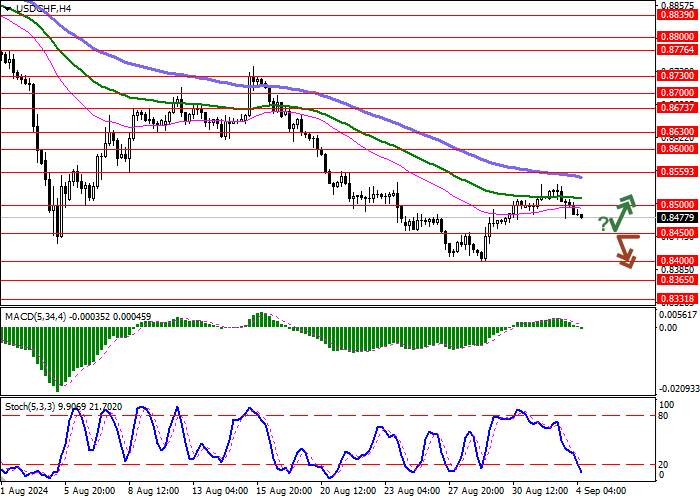
During the Asian session, the USD/CHF pair is testing 0.8480 for a breakdown, developing the “bearish” momentum formed yesterday, when the dollar retreated from the highs of August 23.
On Monday, US trading floors were closed for Labor Day, and investors focused on macroeconomic statistics from Switzerland. The July real retail sales increased from –2.6% to 2.7%, compared to forecasts of –0.2%. In the manufacturing sector, growth was recorded by 2.6% QoQ in the last quarter, and in construction – by 0.1%. However, the decline in the retail segment was 0.4% after two-quarter positive dynamics. Consumer spending rose 0.3%, and government spending rose 0.2% in April-June, while exports fell 5.0% and imports fell 13.8%. The August business activity index rose to 49.0 from 43.5, beating the preliminary estimate of 44.0. Investors yesterday noted the increase in the Q2 Swiss gross domestic product (GDP), from 0.5% to 0.7% QoQ and from 0.6% to 1.8% YoY. In addition, the August consumer price index slowed from 1.3% to 1.1% YoY and was 0.0% MoM. The slowdown in inflation has increased pressure on Swiss National Bank officials to adjust the interest rate further, which was changed by –25 basis points at its meeting on June 20.
At the end of the week, experts expect the publication of the final US labor market report for August. According to preliminary estimates, nonfarm payrolls will change from 114.0K to 160.0K, the average hourly wage – from 0.2% to 0.3% MoM and from 3.6% to 3.7% YoY, and the unemployment rate – from 4.3% to 4.2%.
Support and resistance
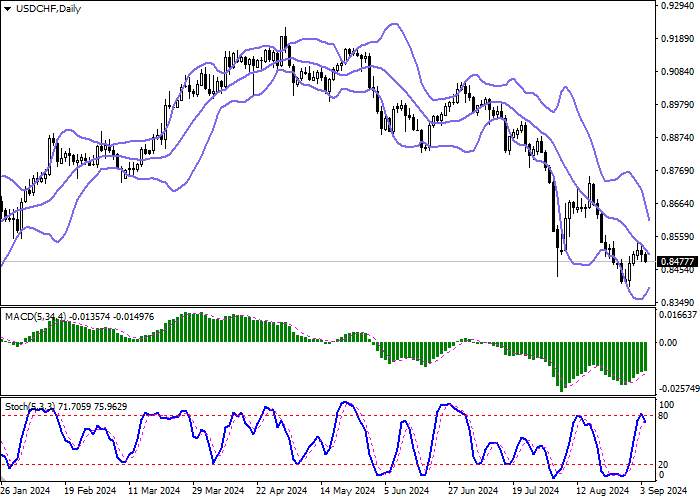
On the daily chart, Bollinger bands are steadily declining. The price range is narrowing, reflecting the emergence of ambiguous trading dynamics in the short term. The MACD indicator is growing, maintaining a poor buy signal (the histogram is above the signal line). Stochastic, having retreated from the highs, is reversing into a downward plane, indicating that the US dollar may become overbought in the ultra-short term.
Resistance levels: 0.8500, 0.8559, 0.8600, 0.8630.
Support levels: 0.8450, 0.8400, 0.8365, 0.8331.
Trading tips
Short positions may be opened after a breakdown of 0.8450, with the target at 0.8365. Stop loss — 0.8500. Implementation period: 1–2 days.
Long positions may be opened after a rebound from 0.8450 a breakout of 0.8500, with the target at 0.8600. Stop loss — 0.8450.





Leave Your Message Now